How mature is your contracting function?
A structured diagnostic across eight dimensions of contracting capability — from ad-hoc to automated — designed to show where you are, where the gaps sit, and what a realistic next step looks like.
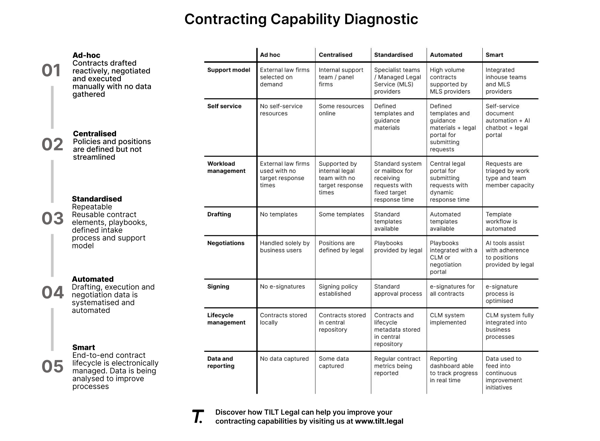
Most teams know their contracting could work better. Few have a framework for assessing how.
Whether contracting sits with legal, procurement, or somewhere in between, most organisations share a similar experience: a general sense that things could be more efficient, but no structured way to evaluate where the real gaps are — or which improvements would make a meaningful difference given current resources and constraints.
This diagnostic provides that structure. It maps eight dimensions of contracting capability across five maturity levels, giving you a clear picture of your current state and a shared language for the conversation about what to prioritise next.
Eight dimensions. Five maturity levels.
Support model
How contracting support is resourced — from ad-hoc external counsel through to integrated teams with managed service providers.
Self-service
The extent to which the business handles routine matters independently, from no resources through to AI-assisted automation and portals.
Workload management
How requests reach the team and how capacity is managed — from informal channels to structured triage.
Drafting
Template availability and automation maturity, from no templates to fully automated drafting workflows.
Negotiations
How positions are defined and applied — from unstructured negotiation to playbook-driven consistency.
Signing
Execution processes, from manual signing through to optimised e-signature workflows across all contract types.
Lifecycle management
Where contracts live post-execution — from local storage to a fully integrated CLM system.
Data and reporting
What data is captured and how it informs decisions — from no data through to continuous improvement driven by reporting.
Who this is for
This diagnostic is useful whether contracting is owned by legal, procurement, operations, or shared across functions. It's designed for the people making decisions about how contracting works — regardless of where that responsibility sits in the organisation.
- You've been asked to improve contracting efficiency but aren't sure where the real bottlenecks sit.
- You're preparing for budget planning and need to articulate which investments would make a measurable difference.
- You're benchmarking your function against industry maturity and want a structured framework — not a generic checklist.
Trusted by
About TILT Legal
TILT Legal is a legal engineering consultancy that builds AI-powered technology for Australian legal teams. This diagnostic grew out of our advisory work with in-house legal teams and law firms evaluating their contracting operations. We use it as a starting point in those conversations, and publish it because a shared framework tends to make the discussion more productive.